
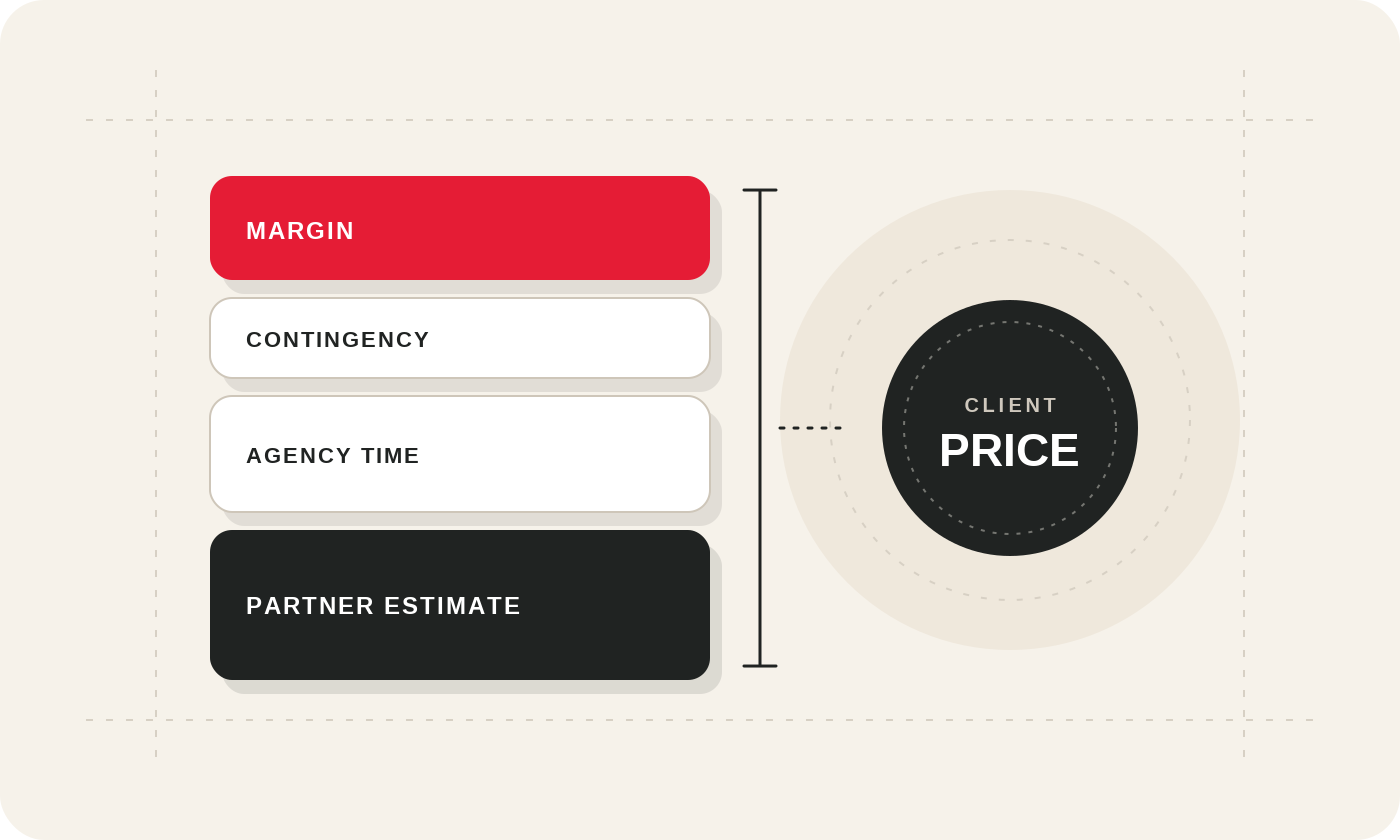
Your development partner has sent an estimate for the build. The client is waiting for a price. The number you send is not the partner's figure with a percentage added; it has to pay for everything your agency does around the build as well.
This guide sets out a way to get from one number to the other. The figures in the worked example are hypothetical. Use your own.
Start with what the estimate covers
Read the partner's estimate as a description of work, not only a total. A dependable estimate states the assumptions behind it, the work included and the work left out.
Check four things before you use the figure:
Scope: which pages, templates or features are included, and which designs they are based on.
Reviews: how many review rounds are included and what counts as a change.
Testing: which browsers and devices are covered.
Handover: what is delivered at the end, and whether launch tasks are included.
If any of these is unclear, ask before you price. A gap in the estimate becomes a gap in your margin. Our website handover checklist for agencies lists the questions worth settling at this stage.
Add the work your agency still does
White-label development moves the build to another team. It does not remove your agency's own effort. List the hours your people will spend on the project and cost them at your normal rate.
The usual items are:
Client management: meetings, emails and presenting the work.
Briefing and review: preparing the brief for the partner, checking each delivery and consolidating client feedback.
Design and content: anything your team produces before or during the build.
Launch support: being available on launch day and for the first questions afterwards.
Agencies often leave this out because it feels like overhead. On a small project it can be a large share of the real cost.
Separate the running costs
Some costs belong to the client and continue after launch: hosting, paid plugins or licences, and any service charged by usage. Keep them out of the project price.
List each one in your proposal with who pays it and who owns the account. This protects your margin, and it avoids a difficult conversation when the first renewal arrives. Account ownership is also one of the points to agree with your development partner before work starts; our guide to when to use a white-label development partner covers that agreement.
Allow for what you cannot see yet
Every project carries some uncertainty: content that arrives late, a third-party system that behaves differently from its documentation, a client who needs an extra review round.
You can handle this in one of two ways. Add a contingency to the fixed price, sized to how complete the brief is. Or keep the price tight and state clearly that work beyond the agreed scope is quoted separately. Either is reasonable. Choosing neither is how fixed-price projects lose money.
Choose how to present the price
There are two common approaches.
Cost-plus adds your costs and applies a margin. It is simple and easy to defend internally. Its weakness is that the price moves with your costs, not with what the website is worth to the client.
Value-based pricing starts from the client's side: what the website is for, and what a good result is worth to them. It suits projects where the outcome is clear, such as an online shop replacing a manual order process. It needs more conversation before you quote.
Many agencies use cost-plus to find the lowest price they can accept, then use the client's situation to decide how far above it to quote.
A hypothetical worked example
An agency is asked for a ten-page brochure website with designs already approved. All figures below are invented for illustration.
Development partner's estimate: 4,000
Agency time, 30 hours at 80 an hour: 2,400
Contingency at 10% of those two lines: 640
Cost before margin: 7,040
Margin at 30% of the final price: 3,017
Price to the client: 10,057
Two points are worth noticing. The agency's own time is more than half the partner's figure, so pricing from the partner's estimate alone would have left it uncovered. And the margin is calculated on the final price, not added to the cost: a 30% margin means dividing the cost by 0.7, which is more than adding 30%.
Hosting and licences are listed separately in the proposal and do not appear in this total.
Decide how changes are priced before they happen
Clients change their minds. Agree the rule at the start, with both the client and your development partner:
A change is compared with the agreed scope.
Its effect on cost and timing is discussed before anyone starts work on it.
One named person on each side can approve it.
When your partner works this way, you can give your client a clear answer about a change quickly, with a figure you can rely on.
Decide whether to mention your partner
Whether the client knows another team is involved is your decision. Some agencies present the partner as part of an extended team; others deliver entirely under their own name. Agree it with your partner in advance, including who attends client meetings and who sends updates.
What matters for pricing is that your price reflects the responsibility you carry. You own the client relationship and the result, whoever writes the code.
A short checklist before you send the quote
The partner's estimate states its assumptions, inclusions and exclusions.
Your own hours are listed and costed.
Running costs are separated, with an owner for each.
Contingency or a change rule is in place.
Margin is calculated on the final price.
The proposal says how many review rounds are included.
If you are pricing a project now, share the brief with us. We can review it and give an indicative estimate, with the assumptions and exclusions set out, so you have a dependable figure to build your price on. Our white-label development service explains how we work with agencies.